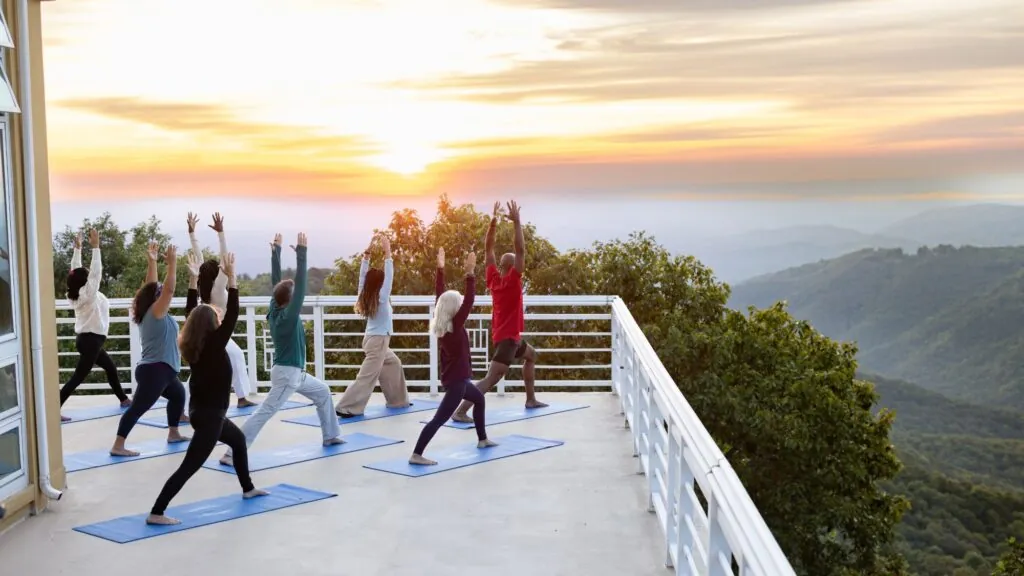
Yoga is often praised for its flexibility and stress relief benefits. Yet one of its most profound gifts is less obvious: yoga simultaneously builds strength and sensitivity — two qualities that may appear opposite but are deeply complementary.
In today’s fast-paced world, many people develop one at the expense of the other. We may become strong but disconnected from our bodies, or highly sensitive but easily overwhelmed. The traditional practice of hatha yoga was designed to restore balance between these forces — and in a retreat setting, this integration can deepen in powerful ways.
Understanding the Meaning of Hatha Yoga
The word hatha is often translated as sun and moon:
- Ha (sun) represents energy, vitality, activation
- Tha (moon) represents calm, cooling, restoration
True yoga does not push us toward constant intensity or constant relaxation. Instead, it teaches the body and mind how to move fluidly between effort and ease.
You can feel this directly in practice
- Stretching postures relax the muscles
- Strength-building poses create stability
- Energizing breathwork (like kapalabhati) stimulates the system
- Cooling practices (like sheetali) quiet the nervous system
- Concentration sharpens the mind
- Meditation settles it into stillness
Yoga, at its core, is a practice of intelligent balance.
Sensitivity: Relearning How to Listen
One of yoga’s most transformative benefits is heightened sensitivity; not emotional fragility, but refined awareness. In yoga, sensitivity means developing the ability to notice subtle signals from the body, breath, nervous system, and the inner self. Modern life often trains us to override these signals. We push through fatigue, ignore tension, eat quickly, and power past stress. Over time, this disconnect can contribute to burnout and imbalance. Yoga gently reverses this pattern.
Through mindful movement and breath awareness, practitioners begin to notice
- Where the body holds tension
- When the breath becomes strained
- How different foods and habits affect energy
- When the nervous system needs rest.
This early awareness is powerful. As the Yoga Sutras teach, future suffering can often be avoided when we learn to recognize imbalance early.
Strength: Building Resilience From the Inside Out
Sensitivity alone, however, is only half the equation. Yoga also systematically builds multi-layered strength.
Physical postures develop muscular support and joint stability. But traditional yoga texts also describe deeper strengthening effects
- Improved digestive function
- Greater nervous system resilience
- Increased tolerance for stress
- Enhanced emotional steadiness
- Stronger capacity to remain centered amid change.
Breathwork and concentration practices further build mental endurance and clarity.
Over time, practitioners often notice they are less reactive, more grounded under pressure, better able to recover from stress, and more emotionally balanced. This is yoga’s quiet power; strength that does not harden, and sensitivity that does not overwhelm.
Why Practicing on Retreat Amplifies the Benefits
While regular classes are valuable, many people find their practice deepens significantly in a retreat environment. Why? Because context matters.
At home, yoga competes with
- Busy schedules
- Constant notifications
- Work demands
- Family responsibilities
- Environmental stressors.
On retreat, the nervous system finally has the conditions it needs to fully downshift.
In an immersive retreat setting, yoga can
- Unwind deeper layers of tension
- Regulate the stress response more fully
- Improve sleep quality
- Enhance mental clarity
- Accelerate mind-body awareness
- Support emotional release and integration.
Perhaps most importantly, retreat creates continuity of practice, which is where real transformation begins.
The Role of Breathwork and Meditation
In traditional yoga, postures are only one piece of the puzzle. Breathwork and meditation complete the circuit. Breathwork (pranayama) helps regulate the autonomic nervous system, supporting both energy and calm. Meditation develops the capacity to witness thoughts without becoming entangled in them — a skill that profoundly supports modern mental health. Together, these practices help shift the body from chronic “doing mode” into a more sustainable rhythm of effort and restoration.
The Sacred Mountain Yoga Retreat Experience
Environment plays a quiet but powerful role in healing. When practice is supported by nature, community, and expert guidance, the benefits of yoga often unfold more naturally. At the Art of Living Retreat Center, the Sacred Mountain Yoga Retreat offers a space where women and men alike can
- Step away from daily pressures
- Reconnect with breath and body
- Experience guided yoga and meditation
- Support nervous system reset
- Deepen self-awareness
- Rest in the quiet beauty of the Blue Ridge Mountains.
Many guests report that insights and shifts arise here with surprising ease—not because they are forced, but because the environment finally allows the body and mind to soften.
The Real Promise of Yoga
Yoga’s true gift is not extreme flexibility or perfect postures. It is the gradual cultivation of a human being who is
- Strong yet soft
- Alert yet relaxed
- Resilient yet responsive
- Grounded yet open.
When practiced consistently, and especially when experienced in an immersive retreat setting, yoga becomes not just an exercise, but a pathway back to natural balance.